Bridging the Gap: How Receptive and Expressive Supports Empower Learners
A commonly used classroom strategy is the use of visual resources to support learners with speech, language and communication difficulties in understanding and participation throughout the school day. Visual schedules, choosing boards and positive behaviour tools are just some of the systems that can support learners when receptive language difficulties are present.
However, we cannot stop there. To create a truly communication‑friendly environment, we must ensure that learners have the resources they need to express themselves. Knowing what to do is one thing, but being able to share your thoughts, feelings and understanding is a vital part of the school day. This is where augmentative and alternative communication (AAC) resources come into play.
Although the same symbols are often used for consistency, it is important to understand the difference between resources designed to support receptive communication and those created for expressive communication. This article aims to share examples of both.
Receptive Communication Resources
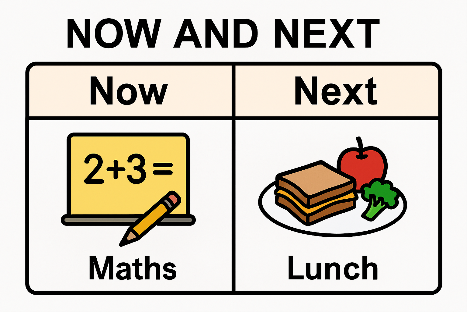
Now and next boards visually represent what is happening right now and what is coming next. They help learners stay focused and can reduce anxiety during transitions by making expectations clear. They can also be used as a behaviour‑support tool, where the ‘next’ activity is chosen to motivate and engage the learner.
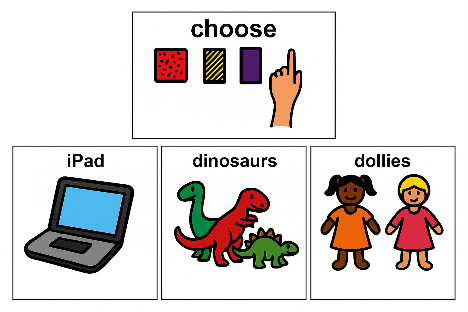
Choice boards present a set of options to pick from. They promote independence, engagement, and decision-making by giving clear, structured choices.
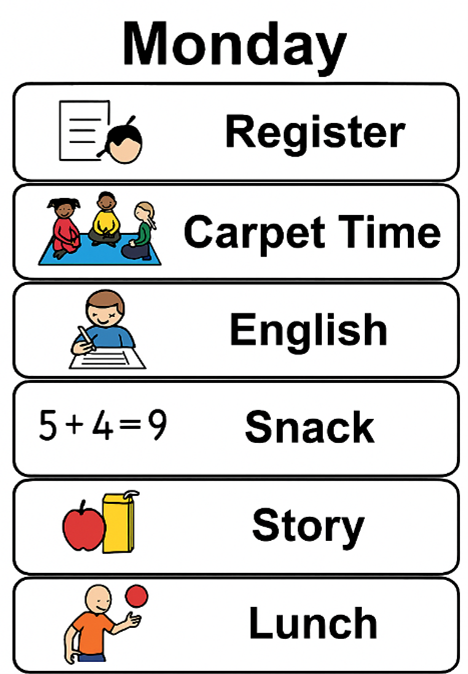
Visual timetables are symbol supported schedules that show activities or events in order throughout the day. They help learners understand what is happening next, feel more prepared and manage transitions more confidently. Activities that have been completed are often ticked off or removed from the timetable, giving the learner an understanding of what has finished and what is still to come.
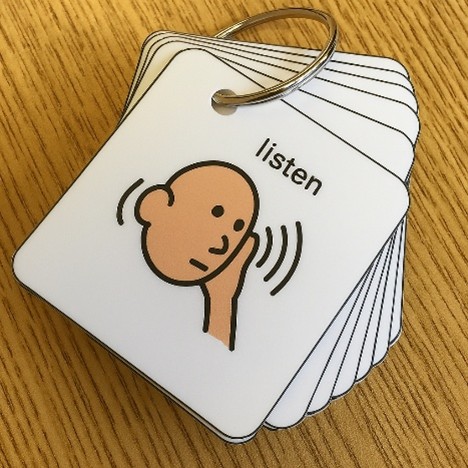
Behaviour visuals show expected behaviours or rules in a clear, precise way. They reinforce positive behaviour by making expectations easy to see and remember, such as stop or listen. These visuals are often presented as a keyring of cards worn by adults on a lanyard or belt loop, supporting the learner by provide consistent and immediate cues.
These receptive communication tools help learners understand what is happening around them. Because they remain visible, unlike verbal speech, and give learners more time to process information and expectations. However, they are not designed to support expressive communication, as they typically offer only a limited range of vocabulary.
Expressive Communication Tools
To help learners develop expressive language and “say what they want to say, when they want to say it” (Porter, 2018), we can offer AAC resources in the classroom and wider school environment.
AAC tools, such as symbol charts, communication books and AAC apps, can support a wide range of communication functions. They enable learners to express their ideas, demonstrate their knowledge and participate more fully in classroom activities. AAC also supports social interaction by giving learners ways to greet others, start conversations and share opinions. In addition, it helps them communicate needs, preferences and emotions, allowing them to engage more confidently throughout the school day.
However, physically providing these tools is not enough. Just as with any language development, learners who may benefit from AAC cannot be expected to use these tools independently without seeing others use them in real situations. This process is called modelling. When modelling AAC, communication partners point to symbols or select vocabulary that match the meaning of the words being spoken.
It is the communication partner’s role to show the learner how language works on their AAC system, without expecting them to imitate or respond. A common risk is that AAC ends up being used only to answer questions in lessons, which limits its purpose. We must ensure learners are also given opportunities to start conversations, share interests and express themselves freely.
For AAC tools to give learners the opportunity to express themselves fully they should include core and fringe vocabulary.
- Core words are flexible and can be used across any context. Whilst using one core word on its own can say a lot (e.g. stop, more, different, go) they can be combined to provide the building blocks for phrases and sentences.
- Fringe vocabulary is specific to the context of the situation and should include a mix of nouns, verbs and adjectives.
Here are some examples of where to get started with AAC tools.
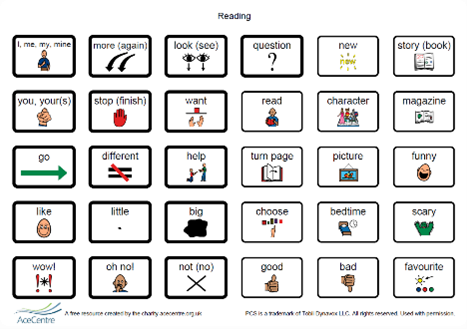
Symbol charts should include a balance of core and topic specific words which enable the learner to communicate for a range of purposes. Create or use symbol charts that have the maximum number of symbols a learner can see and point to on one page. This will provide rich and varied opportunities to learn how to use language through motivating and engaging activities.
We have a wide range of symbol charts covering many topics which you can freely download.
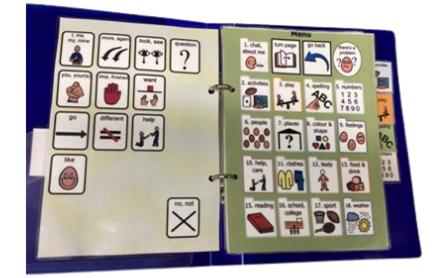
Communication books are multi‑page AAC tools that organises a wide range of vocabulary across different topics, allowing learners to navigate between pages to build more complex messages. Whatever the format, communication books need to be well organised with clear indexes, tabs and helpful page links so that vocabulary is easy to find and partners can model efficient navigation.
AAC apps provide symbol‑based vocabularies that help learners communicate by selecting and combining symbols to form messages. There are many available and they can all differ in layout, navigation, and features like quick phrases or mixed core and fringe vocabulary.
By thoughtfully combining receptive and expressive supports, we create a learning environment where every learner can both understand and be understood. AAC becomes most powerful when it reflects each learner’s identity, interests and priorities. When learners are actively involved in choosing and personalising their AAC, they are far more likely to value it, use it meaningfully, and communicate with confidence.


Follow Ace Centre on social media
Follow us on Twitter
Watch our latest videos via our YouTube channel here
Like us on Facebook here